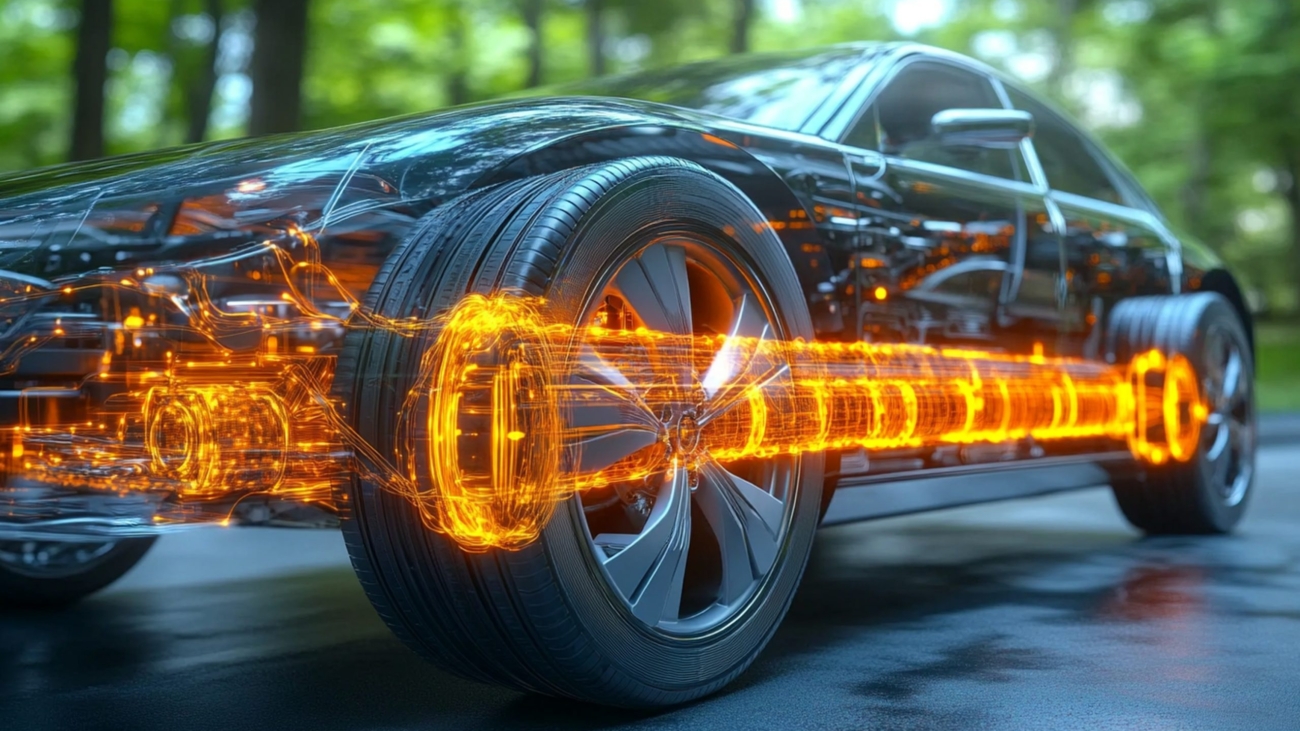
Every time a moving vehicle slows down, its kinetic energy has to go somewhere. In a conventional vehicle, much of that energy becomes heat through the braking system. Electric vehicles can recover a portion of it and return that energy to the battery.
This process is known as regenerative braking, and it changes the way an electric vehicle behaves when the accelerator is released.
Turning Motion Back Into Electricity
An electric motor can operate in two directions from an energy perspective.
During acceleration, electrical energy from the battery is converted into mechanical movement. During regenerative braking, the process is reversed.
The rotating wheels drive the motor, which acts as a generator. Mechanical energy is converted into electrical energy and sent back toward the battery.
The vehicle therefore captures part of the energy that would otherwise be lost as heat.
Regenerative braking does not recover all the energy used for acceleration. Conversion losses occur, and some energy may still be dissipated through conventional friction brakes.
Why One-Pedal Driving Feels Different
Many electric vehicles allow strong regenerative braking when the accelerator is released. Depending on the system, the vehicle can slow significantly without the driver immediately pressing the brake pedal.
This can create a driving style often described as one-pedal driving.
The driver gradually learns to control speed through accelerator position. Releasing the pedal can produce noticeable deceleration, while pressing it again increases forward motion.
Some systems allow the strength of regenerative braking to be adjusted, while others automatically adapt it based on driving conditions.
Regeneration Is Not Always Available at Full Strength
Regenerative braking depends on battery and vehicle conditions.
If the battery is already near its maximum state of charge, there may be less capacity available to accept recovered energy. The vehicle can reduce regenerative braking in these circumstances.
Very cold battery temperatures can also affect regeneration.
When regenerative braking is limited, the vehicle may rely more heavily on conventional friction brakes. The driver may notice that the accelerator-release behavior feels different from usual.
This is normal system behavior rather than necessarily a mechanical fault.
Brake Components Can Have a Different Life
Because regenerative braking handles part of the vehicle's deceleration, friction brakes may experience less use during ordinary driving.
That can reduce wear on brake pads and rotors.
However, reduced use does not mean conventional brakes can be ignored. Brake components still need inspection because corrosion, contamination, seized components, or age-related deterioration can occur even when friction braking is used less frequently.
Some vehicles deliberately apply friction brakes periodically to help maintain their condition.
Regeneration and Driving Efficiency
Regenerative braking can improve overall energy efficiency by recovering part of the energy associated with deceleration.
The greatest benefit occurs when the vehicle frequently changes speed, such as during urban driving. However, regeneration does not make stop-and-go driving free from energy consumption.
Accelerating and then immediately recovering a portion of that energy during braking still involves conversion losses.
Smooth driving remains important. Anticipating traffic and maintaining appropriate speed can reduce unnecessary acceleration and deceleration in the first place.
Understanding the Driver's Role
Regenerative braking creates a closer relationship between the driver and the vehicle's energy system.
Small changes in accelerator position can influence both speed and energy flow. Drivers may eventually learn to anticipate traffic lights, curves, slopes, and slowing vehicles more smoothly.
The experience can feel very different from driving a combustion-powered vehicle.
Regeneration is more than a technical feature. It represents a different approach to motion in which braking can become part of the energy-management process rather than simply the end of acceleration.